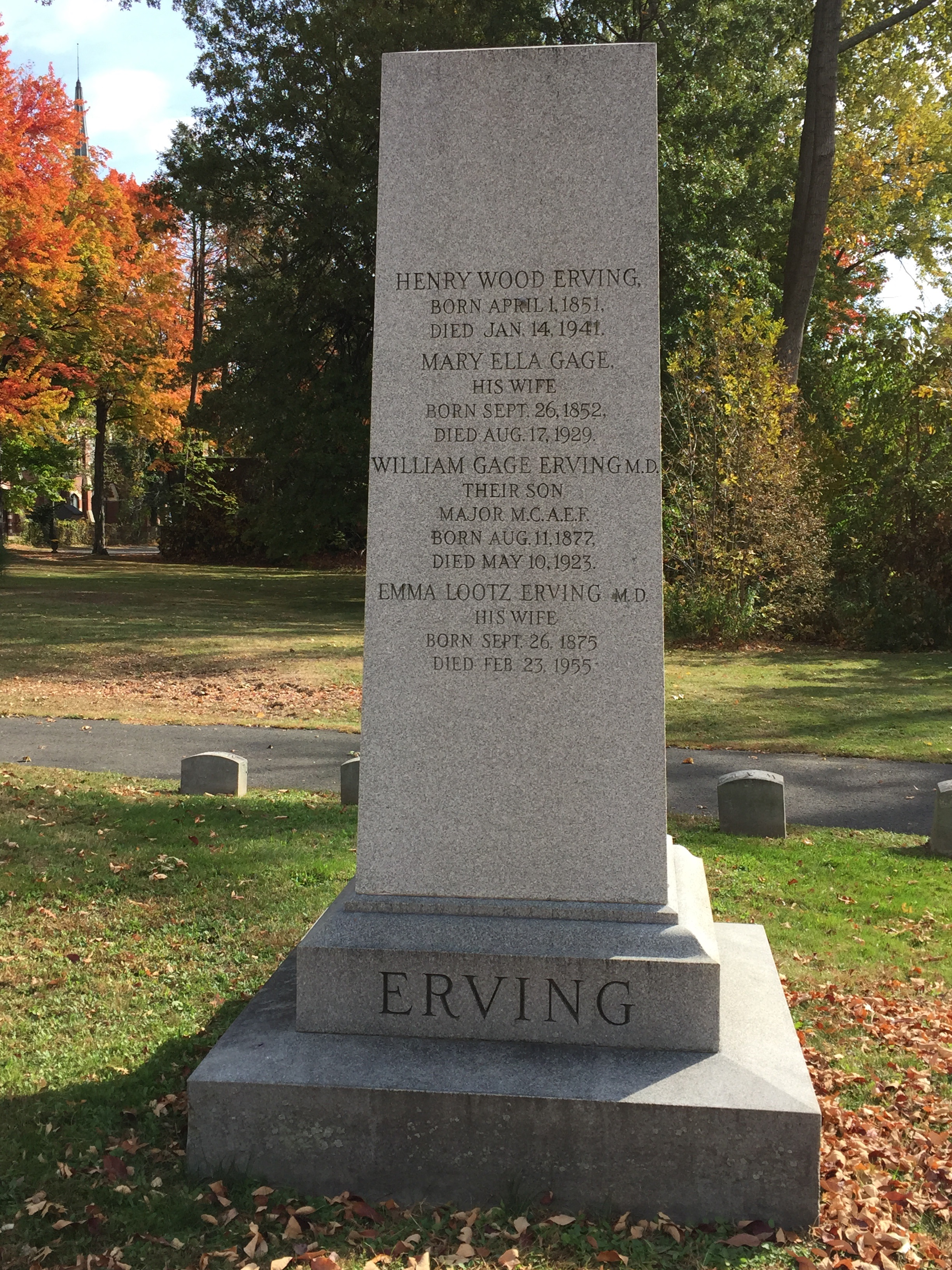
 Henry Wood Erving (April 1, 1851 - January 14, 1941) was a prominent American banker, antiquarian, and pioneer collector of early American decorative arts.
Queer Places:
821 Prospect Ave, Hartford, CT 06105, USA
Spring Grove Cemetery, 2017 Main St, Hartford, CT 06120, United States
Henry Wood Erving (April 1, 1851 - January 14, 1941) was a prominent American banker, antiquarian, and pioneer collector of early American decorative arts.
Born in Connecticut in 1851, he spent much of his professional career serving in executive banking roles, notably as vice president of the Connecticut River Banking Company in Hartford. Outside of his financial career, he married Mary Ella Gage, with whom he had a son, Dr. William Gage Erving (1877–1923). Around 1880, Erving built a notable Queen Anne style home on Prospect Avenue in West Hartford, adjacent to his brother William's house.
Alongside contemporaries like Wallace Nutting and Luke Vincent Lockwood, Erving was instrumental in defining the study and appreciation of early New England craftsmanship during the late 19th and early 20th centuries.
Erving is widely credited with discovering, identifying, and naming the "Hadley chest"—a distinct group of 17th- and early 18th-century carved New England storage chests originating from the Connecticut River Valley.
He authored several early treatises on regional material culture, including Random Notes on Colonial Furniture (1922) and The Hartford Chest.
Over 100 pieces from his extensive collection of New England furniture were featured in classic reference texts such as Wallace Nutting’s Furniture Treasury and Luke Vincent Lockwood’s Colonial Furniture in America. Many of his pieces later entered major museum collections, including the Metropolitan Museum of Art and the Wadsworth Atheneum.
The Horace Walpole Society was founded in early 1910 as an exclusive, invitation-only gentlemen’s organization composed of leading collectors, curators, scholars, and antiquarians dedicated to early American decorative arts and architecture. Named after the British writer and collector Horace Walpole, the society served both as an intellectual circle and a social network for the nation's premier connoisseurs.
Henry Wood Erving was elected as one of the original charter members in 1910, shortly after the society's formal organization in Hartford on January 21, 1910.
As a Walpole Society member, Erving frequently consulted for major cultural institutions. Notably, in 1918, he collaborated with fellow "Walpolean" Richard Townley Haines Halsey to appraise the George S. Palmer collection of American furniture prior to its acquisition by the Metropolitan Museum of Art for its American Wing.
Erving remained an active and respected figure within the Walpole Society until his death in 1941.
While Henry Wood Erving was heteronormatively married and raised a family, his historic footprint intersects with LGBTQ history and modern queer studies in two key ways:
The Horace Walpole Society itself occupies a unique position in LGBTQ architectural and decorative arts history. Named after Horace Walpole—a figure whose life, bachelorhood, and aesthetic sensibility are widely studied within queer history—the society catered to an exclusive homosocial circle of male collectors, scholars, and museum professionals.
In modern archival and queer history scholarship (such as in works documenting queerplaces and LGBTQ decorative arts networks), the Walpole Society is frequently highlighted because many of its foundational members, curators, and donors were gay men or lived in same-sex domestic partnerships. Figures within or closely connected to this network—such as Henry Watson Kent (securing collections for the Met) or later Walpoleans like Henry Francis du Pont—helped shape American aesthetic history through close-knit, male-centered social and professional bonds.
Archival correspondence preserved in the Walpole Society papers at the Winterthur Museum reveals Erving's private reflections on the internal dynamics and social propriety of early 20th-century collecting circles. In a 1918 letter to co-founder Henry Watson Kent, Erving discussed fellow collectors and expressed concerns over commercialism and private rivalries disrupting the camaraderie of their shared community. Scholars examining collectors' personal papers often look at these candid exchanges between Erving, Kent, and Norman Morrison Isham to understand how early 20th-century male networks navigated personal boundaries, shared aesthetic passions, and institutional influence.
References:
Support this project
This website is a passion project researched, developed, and funded entirely by me. If you find the content valuable and would like to help support the ongoing research and hosting costs, any contribution is deeply appreciated.
Thank you for keeping this independent resource alive!
My books on Amazon: Elisa Rolle's books